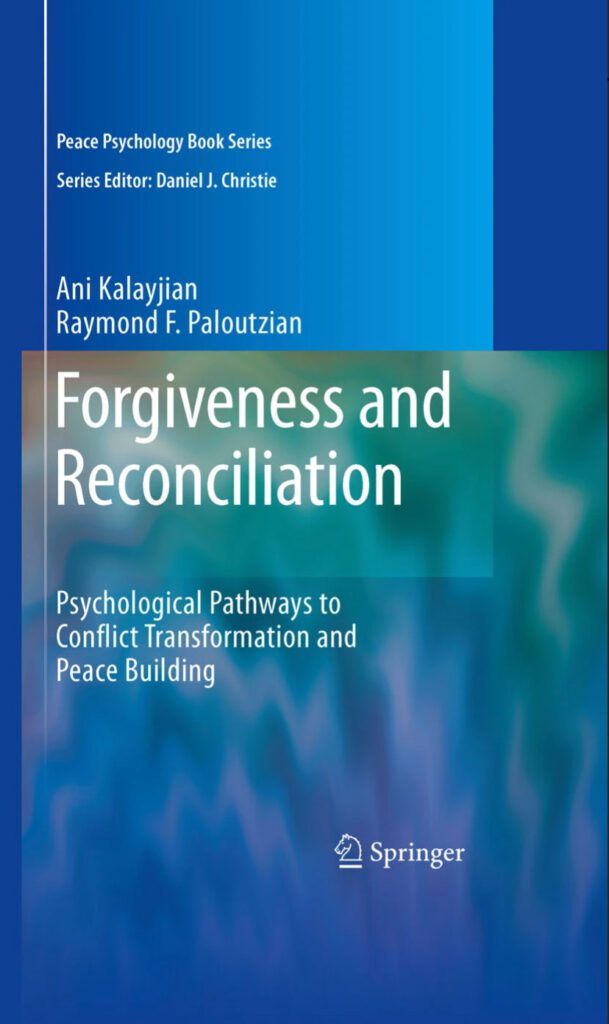
Forgiveness and Reconciliation Psychological Pathways to Conflict Transformation and Peace Building

#72751
Edited Book

Articles

Title: Introduction: Issues and Themes in Forgiveness and Reconciliation, Pages 3-10
Title (english): Introduction: Issues and Themes in Forgiveness and Reconciliation, Pages 3-10
Author(s): Ani Kalayjian, Raymond F. Paloutzian, Raymond F. Paloutzian

Title: A Systemic Framework for Forgiveness, Reconciliation, and Peace: Interconnecting Psychological and Social Processes, Pages 11-32
Title (english): A Systemic Framework for Forgiveness, Reconciliation, and Peace: Interconnecting Psychological and Social Processes, Pages 11-32
Author(s): Robert F. Massey, Khawla Abu-Baker

Title: Forgiveness and Relational Ethics: The Perspective of the Contextual Therapist, Pages 33-54
Title (english): Forgiveness and Relational Ethics: The Perspective of the Contextual Therapist, Pages 33-54
Author(s): Catherine Ducommun-Nagy

Title: The Psychology of Forgiveness in the World Religions, Pages 55-70
Title (english): The Psychology of Forgiveness in the World Religions, Pages 55-70
Author(s): Charles E. Farhadian, Robert A. Emmons

Title: The Bullet and Its Meaning: Forgiveness, Nonforgiveness, and Their Confrontation, Pages 71-80
Title (english): The Bullet and Its Meaning: Forgiveness, Nonforgiveness, and Their Confrontation, Pages 71-80
Author(s): Raymond F. Paloutzian

Title: Forgiveness and Reconciliation: Essential to Sustaining Human Development, Pages 83-96
Title (english): Forgiveness and Reconciliation: Essential to Sustaining Human Development, Pages 83-96
Author(s): Sharon Davis Massey

Title: Art and Meaning: ARTiculation© as a Modality in Processing Forgiveness and Peace Consciousness, Pages 97-119
Title (english): Art and Meaning: ARTiculation© as a Modality in Processing Forgiveness and Peace Consciousness, Pages 97-119
Author(s): Hagitte Gal-Ed

Title: Promoting Forgiveness Through Restorative Conferencing, Pages 121-136
Title (english): Promoting Forgiveness Through Restorative Conferencing, Pages 121-136
Author(s): Augustine Nwoye

Title: Guilt, Responsibility, and Forgiveness: Lessons from Lifers in Prison, Pages 137-151
Title (english): Guilt, Responsibility, and Forgiveness: Lessons from Lifers in Prison, Pages 137-151
Author(s): Dan Cohen

Title: A Black Social Psychologist's Perspective on Racial Forgiveness, Pages 155-170
Title (english): A Black Social Psychologist's Perspective on Racial Forgiveness, Pages 155-170
Author(s): Ansley W. LaMar

Title: Rwanda: Repentance and Forgiveness – Pillars of Genuine Reconciliation, Pages 171-187
Title (english): Rwanda: Repentance and Forgiveness – Pillars of Genuine Reconciliation, Pages 171-187
Author(s): Antoine Rutayisire Rutayisire

Title: Darfur: Efforts to Forgive and Reconcile in an Unresolved Conflict, Pages 189-206
Title (english): Darfur: Efforts to Forgive and Reconcile in an Unresolved Conflict, Pages 189-206
Author(s): Suliman A. Giddo

Title: India and Pakistan on the Brink: Considerations for Truth, Reconciliation, and Forgiveness, Pages 207-221
Title (english): India and Pakistan on the Brink: Considerations for Truth, Reconciliation, and Forgiveness, Pages 207-221
Author(s): André L. Brown, Rhea Almeida, Anita Dharapuram

Title: Forgiveness in the Context of the Armenian Experience, Pages 223-235
Title (english): Forgiveness in the Context of the Armenian Experience, Pages 223-235
Author(s): Viken Yacoubian

Title: Forgiveness in Spite of Denial, Revisionism, and Injustice, Pages 237-249
Title (english): Forgiveness in Spite of Denial, Revisionism, and Injustice, Pages 237-249
Author(s): Ani Kalayjian

Title: Reconciliation and Forgiveness in Divided Societies: A Path of Courage, Compassion, and Commitment, Pages 251-268
Title (english): Reconciliation and Forgiveness in Divided Societies: A Path of Courage, Compassion, and Commitment, Pages 251-268
Author(s): Paula Green

Title: Dialogue, Forgiveness, and Reconciliation, Pages 269-285
Title (english): Dialogue, Forgiveness, and Reconciliation, Pages 269-285
Author(s): Barbara S. Tint

Book Details

Book Title: Forgiveness and Reconciliation Psychological Pathways to Conflict Transformation and Peace Building
Book Title (english): Forgiveness and Reconciliation Psychological Pathways to Conflict Transformation and Peace Building
Editor(s): Ani Kalayjian Kalayjian, Raymond F. Paloutzian
ISBN Paperback: 978-1441901804
ISBN eBook: 978-1-4419-0181-1

Language

Language: English

Publisher

Publisher: Springer
Town: Berlin
Year of Publication: 2010

Summary

We all long for peace within ourselves, families, communities, countries, and throughout the world. We wonder what we can do about the multitude of con?icts currently wreaking havoc across the globe and the continuous reports of violence in communities as well as within families. Most of the time, we contemplate solutions beyond our reach, and overlook a powerful tool that is at our disposal: forgiveness. As a genocide survivor, I know something about it. As the genocide unfolded in Rwanda in 1994, I was devastated by what I believed to be the inevitable deaths of my loved ones. The news that my parents and my seven siblings had indeed been killed was simply unbearable. Anger and bitterness became my daily companions. Likewise, I continued to wonder how the Hutus and Tutsis in Rwanda could possibly reconcile after one of the most horrendous genocides of the 20th century. It was not until I came to understand the notion of forgiveness that I was able to see the light at the end of the tunnel. Common wisdom suggests that forgiveness comes after a perpetrator makes a genuine apology. This wisdom informs us that in the aftermath of a wrongdoing, the offender must acknowledge the wrong he or she has done, express remorse, express an apology, commit to never repeating said harm, and make reparations to the extent possible. Only then can the victim forgive and agree to never seek revenge.

Summary (English)

We all long for peace within ourselves, families, communities, countries, and throughout the world. We wonder what we can do about the multitude of con?icts currently wreaking havoc across the globe and the continuous reports of violence in communities as well as within families. Most of the time, we contemplate solutions beyond our reach, and overlook a powerful tool that is at our disposal: forgiveness. As a genocide survivor, I know something about it. As the genocide unfolded in Rwanda in 1994, I was devastated by what I believed to be the inevitable deaths of my loved ones. The news that my parents and my seven siblings had indeed been killed was simply unbearable. Anger and bitterness became my daily companions. Likewise, I continued to wonder how the Hutus and Tutsis in Rwanda could possibly reconcile after one of the most horrendous genocides of the 20th century. It was not until I came to understand the notion of forgiveness that I was able to see the light at the end of the tunnel. Common wisdom suggests that forgiveness comes after a perpetrator makes a genuine apology. This wisdom informs us that in the aftermath of a wrongdoing, the offender must acknowledge the wrong he or she has done, express remorse, express an apology, commit to never repeating said harm, and make reparations to the extent possible. Only then can the victim forgive and agree to never seek revenge.

×